

Gurdjieff’s sacred movements are a form of meditation in motion, a path of mindful presence that engages the body, heart, and mind in a living unity. They allow one to enter into an awakened attention—a consciousness that no longer separates spiritual practice from daily life.
Through rhythm, silence, and right effort, they offer a space where consciousness can unfold within the body, eventually becoming a form of embodied prayer.


These movements are not just an art or a physical exercise, but an inner discipline, a path of awakening. Each gesture becomes an invitation to know oneself, to see oneself without complacency and without judgment.
True freedom is discovered—not through the absence of constraints, but through mindfulness in action. Through repetition, observation, and coordination between the motor, emotional, and intellectual centers, the practice opens a space for balance and transformation. It acts as a mirror where automatisms, fears, and resistances are revealed—not to be judged, but to be moved through.
Thus, little by little, attention clarifies, breathing calms, and the body becomes an instrument of consciousness. In this process, movement ceases to be external: it becomes an offering, a way of inhabiting the world with rightness, verticality, and silent love.

Born in the Caucasus in 1872, George Ivanovich Gurdjieff devoted his life to the search for ancient knowledge capable of uniting science, art, and spirituality. From a young age, he was driven by an essential questioning of the meaning of life, the nature of the soul, and the hidden potential of the human being.
Becoming an explorer of the sacred in search of truth, he traveled through Asia, the Middle East, and North Africa looking for communities that were guardians of these secret teachings—monks, dervishes, sages, and Sufi masters who transmitted through their presence what words could not say.
From these travels, a radically new method of awakening was born: the Fourth Way, a path of transformation at the very heart of ordinary life. Unlike purely religious, intellectual, or ascetic paths, Gurdjieff proposed working in daily life, through movement, relationships, and conscious effort.
It was through sacred dances, inspired by ancient rituals observed in Eastern monasteries, that he transmitted this knowledge. These choreographies, which he called Movements, constitute a universal language connecting the human to the cosmos.
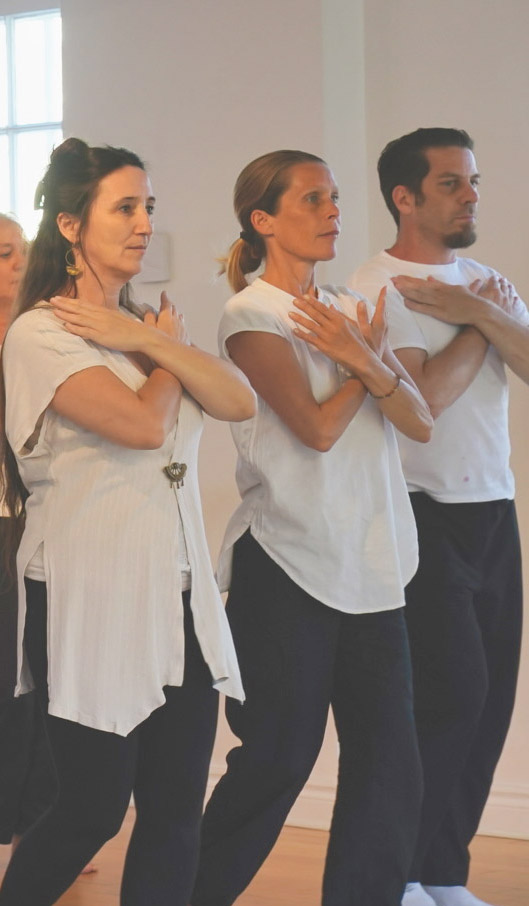

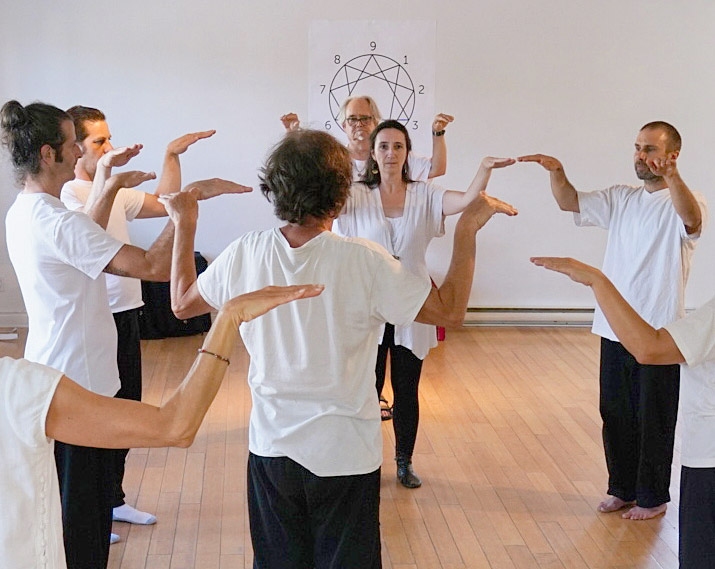
Sacred movements are both demanding and accessible: they require no artistic talent, but rather a quality of sincere engagement and inner availability. They are practiced in a group, guided by a teacher, in an atmosphere of silence and concentration. Each series of gestures invites the development of divided attention—being aware of movement, rhythm, breathing, and the presence of others all at once. Through repetition, precision, and sometimes extreme slowness, the body becomes an instrument for tuning the soul.
Gurdjieff’s sacred movements are divided into several families: the Obligatories, which lay the foundation for the physical vocabulary and refine posture; the dynamic Dervish movements, which awaken determination and mastery of energy; the Temple Dances, imbued with devotion and gentleness; the Multiplications, which awaken group consciousness to universal laws; and the Prayers, slow and internalized, which connect to inner silence.
Each of these forms acts as a different mirror of the same work: uniting instinctive, emotional, and intellectual forces to give birth to a total presence. Learning becomes a path of integration where consciousness flows freely between heaven and earth. In this movement between precision and surrender, something within opens—a quiet clarity, an objectless joy. This is where the gesture becomes prayer, and life becomes meditation.


Invitations to meditative practices and inspiring retreats.
Copyright © 2026 Sensati
Nous utilisons des cookies pour améliorer votre expérience sur ce site.
En poursuivant votre navigation sur ce site, vous consentez à l'utilisation de cookies.
Gérez vos préférences en matière de cookies ci-dessous :
Essential cookies enable basic functions and are necessary for the proper function of the website.
